
Rosecrans 14

September 20th, 2006

Rosecrans 14

Journal Entry for Sketch #14

I leave the building and walk down the hill to the gateway by the road. I am reading the pamphlet as I walk. It tells me there are 9 Medal of Honor Winners buried here. I think maybe I am to sketch by one of these graves today. Surprisingly only three died in action. The pamphlet also tells me there is a plaque near the entrance honoring those whose remains have never been recovered. I walk down the hill looking for this plaque, but instead discover a gravestone inscribed with “Medal of Honor”. But, when I read the names from the pamphlet the recipient is not on the list. I decide the least I owe this man is to return and tell Charlie to add him to the revised pamphlet when it is printed again, so I walk back to the Visitor’s Center. But it is closed. I turn around and as I do I observe an African-American man walking towards me. He walks up to me and says, “Are you here to meet me?” I am stunned and do not know how to respond, so I ask him why he is here. He tells me that he is here to day (my last day of the project) to arrange for the funeral of his friend who just died in Iraq. I tell him I cannot help him with this but I am stunned by the coincidence of this last major encounter I have at the site. I go to the other side of the cemetery to look for the Medal of Honor Winners. I see two huge ships docked below in the harbor. I photograph them as a backdrop to the gravestones. A new stone catches my eye:

Arthur A Cidester
Col. USMC
WW II-Korea
Purple Heart-POW
1913-1954

This is the first POW I have seen. The Korean War ended 1953 - did he die there? Then, I encounter another group of Vietnam War dead, 26 in all, all Purple Hearts. I complete Sketch #12 here by the grave of Anund Roak, Sergeant U.S. Army, killed in Vietnam at 20 years of age May 16, 1968 the year I gradated from High School. Nearby I find is the grave of the first Medal of Honor winner listed in the cemetery pamphlet; and, one of only three who died in action.

Herbert C Jones
ENS US Navy
Medal of Honor
Died in Action at Pearl Harbor
1/21/18 - 12/17/41
27 at death

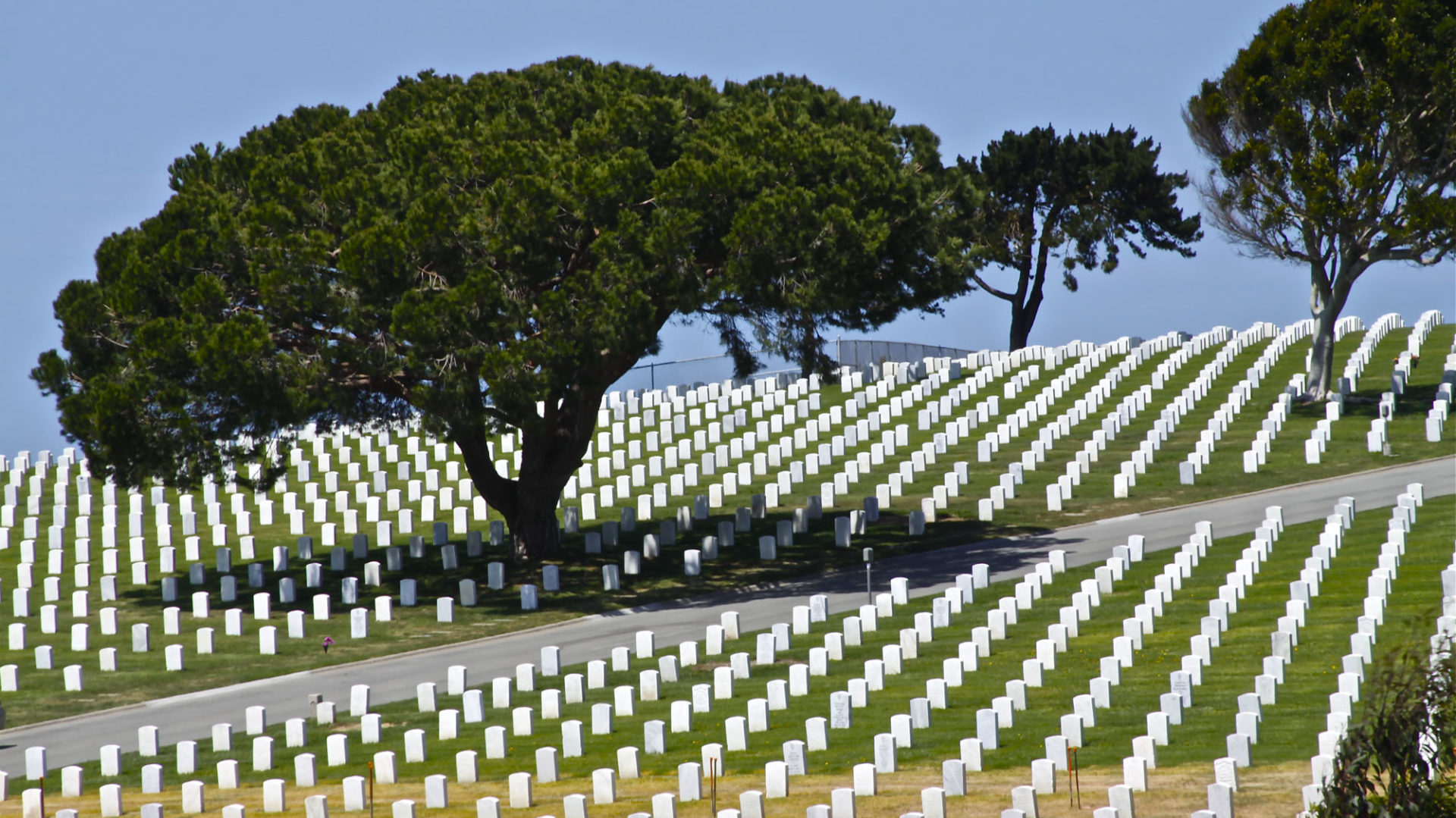
No flags in the cemetery today except at the main entrance as usual. Nor are there many visitors today at the cemetery. The marble gravestones sit stark against clear blue skies drenched in a marble white light. But, I am still intent on finding a soldier who died in WWI to complete the project. I have researched several soldiers who I believe are from this war at the records kiosk and believe them to be in Post Section 8 in the middle of the Southside of the cemetery where I am now. I find the section but the graves are not there. I begin to realize that I am seeing a lot of gravestones in this area that have certain unusual characteristics. They do not have record numbers on them like those from other wars. Nor is the name of war listed on the tombstones. They all have this shield symbol on them with the dead’s name inside. I conclude after looking at a number of gravestones like this that the typical WWI gravestone has a shield on it with only name and rank and/or service dates listed. Confirming my conclusions one says “Died France 2/2/17″.

Gale S. Stephenson
M.T.Co. 3.2.MC
Born 1/11/78
Died France 2/2/17
39 years old a death

postscript

Finished sculpting last sculpture of series on March 19, 2005
Exactly two years after start of Iraq War.

>> Next: End of Series: Poseidon’s Epiphany

<< Return to Rosecrans Main Page

The Beginning: The Passing of the Warrior Class

September 12th, 2006

Beginning Piece that Inspired the Series

Passing of the Warrior Class
The Passing of the Warrior Class

The consensus on this piece was that it represents a passing of the need for a warrior class in society. The piece is interesting because it appears to use the motif of an older Japanese print by Katsushika Hokusai called “The Wave” where a large wave is about to crush a small boat at sea. In this case soldiers on the boat are being overtaken by the force of the sea and an apparition, perhaps of portending the passing of war, rides in the rear of the boat.

>> Next: Journal Entry for Sketch #1

<< Return to Rosecrans Main Page

End of Series: Poseidon’s Epiphany

September 12th, 2006

First Piece After the End of the Series

Poseidon's Epiphany

Poseidon’s Epiphany

When I finished the series I needed one more piece to fill the final kiln load to be fired. Poseidon’s Epiphany was the piece chosen. When I brought this piece to a group naming event, it emerged that all felt it had to do with an old Greek myth about the founding of Athens. It seems there was a great contest to name the City and Poseidon vied with Athena to name it. The gods then said that whichever of the two could come up with the greatest contribution to humankind would win the naming rights. Poseidon went first and created the horse, the quintessential animal of war. All the gods were amazed and thought he could not be beat. Then Athena created the olive tree, symbol of peace and prosperity in the Middle East for ages and won the contest. Thus the piece represented a hope that the purpose of the Rosecrans series was being fulfilled.

<< Return to Rosecrans Main Page

Rosecrans 1

September 11th, 2006

rosecrans1

Journal Entry for Sketch #1
March 16th: 3 Days before Start of U.S./Iraq War

This is my first visit to the cemetery. Getting oriented and trying to figure out how to find graves of those who died in war. I wander through cemetery and finally sit down to sketch.

>> Next: Journal Entry for Sketch #2

<< Return to Rosecrans Main Page

Rosecrans 2

September 11th, 2006

rosecrans2

Journal Entry for Sketch #2
March 23rd: 4 Days After Start of U.S./Iraq War

0 Dead Day 1
2 Dead From Day 2, Both buried at Rosecrans

This is my second visit to the cemetery. I am still trying to find ways to locate those who died in war.

>> Next: Journal Entry for Sketch #3

<< Return to Main Page

Rosecrans 3

September 11th, 2006

rosecrans 3

Journal Entry for Sketch #3
March 29th: 20 Days After Start of U.S./Iraq War

This is my third visit to the cemetery. I am still trying to find ways to locate those who died in war. I have not yet started journaling. Initially I am drawn to research war dead through cemetery records but not sure where to find them.

>> Next: Journal Entry for Sketch #4

<< Return to Rosecrans Main Page

Rosecrans 4

September 11th, 2006

rosecrans4

Journal Entry for Sketch #4
April 6, 2003: Researching The Cemetery

I discover a kiosk near Visitor Center where records of burials and a map machine for locating graves by name is located. Begin to research locations of war dead by going through record books. Strategy is to find soldiers who were in their early 20’s and/or died during the time they fought in a particular war. In record book DOD = Date of Death, however, find that often entries in book are DOI = Date of internment (burial at cemetery) not date of soldier’s death.

Note that usually war or wars that soldier fought in are listed on tombstones as well as service branch and sometimes rank, but not always. Later discover that many of Vietnam dead do not list name of war on tombstone, perhaps because they did not want to be identified with this war.

Based on date of death I look up graves for soldiers who appeared to have died in war based on known dates of wars e.g. WWII 1940-42. Map machine at kiosk allows you to print out locations of grave once name is found in record book. I print out 11 dead using map machine, but I am only able to find three graves in field. System is not accurate. Three are listed below.

I begin to take pictures of tombstones I visit as well as cemetery in general. I take pictures of three tombstones I find:

Nathaniel Charles Wasser, Jr.
Pennsylvania
MUI USNAVY
WWII/Korea/Vietnam
12/30/20-10/26/72

52 years old at death-may have died in Vietnam because of year of death.

Andrew L. Anderson
Flt. O U.S Army Air Corps
WWII
Purple Heart POW
6/21/19-1/23/92

73 years old at death. Probably did not die in war.

Samuel Ray Wideberg
CDR US Navy
WWII/Korea/Vietnam
1920-2002

82 years old at death. Probably did not die in war.

Begin to decipher some of the acronyms found on the tombstones:

KIA = Killed in Action PH = Purple Heart
POW = Prisoner of War CDR = Commander
Flt. O = Flight Officer CPL = Corporal
PFC = Private First Class ENS = Ensign

I conclude that it will not be easy to locate war dead using existing written records available at kiosk since maps often do not give adequate direction to graves and/or do not reflect actual date of death. Also there is no one to ask since Visitor Center is always closed on the weekends and holidays when I come to sketch.

>> Next: Journal Entry for Sketch #5

<< Return to Rosecrans Main Page

Rosecrans 5

September 11th, 2006

rosecrans5

Journal Entry for Sketch #5
April 12, 2003: Palm Sunday

Slowly the logic of Fort Rosecrans National Cemetery reveals itself to me. My first several visits found me wandering through the gravestones looking for those who had died during our wars. There is a truncated language here which reveals itself only slowly to observation, intuition, and logic. Some wars have special logos on the stones, e.g. Spanish American War. Many stones have religious logo e.g. Cross in a circle = Christian, Star of David in a circle = Jewish.

Wives buried with their husbands are listed on the backs of the stones. Usually the branch of service (Army, Navy, Marine Corps, Air Force, etc.) and rank are given. Almost always the war(s) fought in are listed, although not always as noted for Vietnam.

I keep looking for soldiers who died in action, first scanning birth and death dates on gravestones, later going to the record books at the Visitor Center to try to match dates of death with war dates:

WWI 1919-1920
WWII 1940-1944
Korea 1950-1953
Vietnam 1966-1975
Iraq 2003-?

Finally, I see “KIA” on a stone and realize this means Killed in Action.

Initially, I wander through areas figuring the dead are buried by war. But then I realize that graves are arranged by date of death and therefore there is generally a mixture of soldiers who fought from several wars in each area who all died at the same time. In addition, because the cemetery is now nearly full more recent deaths are having to be squeezed in along the edges of earlier graves in order to honor them. I read in the paper that some of the Iraq War dead are being buried here but I have no idea where or even their names. I suspect they are being squeezed in at dispersed locations around the cemetery, so they will be difficult to locate.

I decide that traditional rational research is not helping me find these graves so I make a decision to use only my intuition to locate them. Initially I drive through the cemetery looking for fresh graves knowing the Iraq dead were recently buried, but I find none. Then I am “lead” to the southwestern corner of the cemetery by my intuition and there right beside the road is a single fresh grave. The dead soldier is Brian Mathew Kennedy KIA Iraq one of the first four soldiers to die on March 20, 2003 only three weeks before. The grave is still fresh with only grass seed covering its surface. I realize he wasn’t here when I first visited the cemetery.

Brian Mathew Kennedy
10/1/77-3/20/03
CPL US Marines
Persian Gulf Iraqi Freedom
KIA Purple Heart
10/1/77-3/20/03
“son and brother”

25 years old at death - one of first four killed in this war

I later find out that he died in an accidental helicopter crash at the Kuwait border before even getting into Iraq and that he was buried in San Diego because this is where his unit came from, although he was from Houston, Texas.

As I sit down to sketch by the grave, two young boys come by and want to know who I am. They say they are putting flowers on the graves. I tell them I am an artist sitting with the dead listening for messages; but I have already decided not to go into details about my project in order to avoid upsetting any relatives. However, the boys keep wanting me to tell them what I am drawing. I tell them I do not know. Gradually they come to understand that it is not for me to say. One calls himself “Lucas” but he prefers to be called “Luke”, perhaps from the Bible.

After I finish the sketch I wander around Brian’s grave. In the same row as Brian I find:

Ronald Lee Reynolds
Indiana
ADJ3 USNAVY
3/9/40-6/16/66

No war noted but probably died in Vietnam at age 26

and

Michael Raymond Kiehl
California
PFC CO A-1 BN
173 ABN BDE
Vietnam
12/9/44-5/19/66

Probably died in Vietnam at age 19
Two rows up I find:

Martin Lee Watkins
California
PFC CO C 25 INF DIV
Vietnam
PH
8/14/47-6/4/66

Born two days after Nagasaki nuclear bombing, probably died in Vietnam at age 18.

>> Next: Journal Entry for Sketch #6

<< Return to Main Page

Rosecrans 6

September 11th, 2006

Rosecrans 6

Journal Entry for Sketch #6
April 19th-Easter Sunday

Today about 100 feet along the road from Brian Kennedy’s grave, I find two more who died during the first two days of Iraq War—one a marine who died in the same accidental helicopter crash as Brian Kennedy and the second a navy lieutenant who died in a second accidental helicopter crash on the second day of the war.

Jay Thomas Aubin, Major
US Marine Corps
Persian Gulf Iraqi Freedom
8/8/66-3/20/03
“Our sweet pea”
Died at age 36-second of first four killed in this war

and

Thomas Mullen Adams
LT. US Navy
Persian Gulf Iraqi Freedom
4/16/75-3/21/03
“He’s just pining”
Died at age 28 - one of soldiers killed on 2nd day of war

No one is at these graves when I arrive. Recreating bicyclists and joggers pass by on road at top of ridge. I note it is low tide. Note new grass germinating on grave of Brian Kennedy since last week. Also, a new potted pink tulip tipped over near his head stone. I sketch near the new dead with my back against the head stone of another Vietnam dead: Thomas Frederickson Bruck, 1935-1966, SRK.

Mockingbirds churl in the nearby trees. A dull buzz of machinery noise emanates from the military docks below in the harbor; and, I hear planes taking off from the more distant North Island Naval Air Station to the south across the bay entrance. Only one other woman is in the graveyard. She is dressed in a black business suit and has parked her recreational vehicle along the cemetery loop road near the ridge top. I see her first searching, then finding, then standing silently at the grave of her loved one.

I pray for guidance from these war dead as I look off to the Mexican mountains on the southern horizon. I think ‘there is no way to know whether these Iraqi War dead were courageous or merely victims at their death.” We can be fairly certain the Iraq dead died obeying orders in a military they had joined voluntarily unlike the majority of the Vietnam dead. Sadly, it appears from my last two visits, that these recent dead are being visited/honored by few other than close family. I wonder at our national embarrassment at visiting those who have died in our wars.

I discover another Vietnam Vet, Michael Hart, U.S. Navy, died 1979, at age 40. Because of his age I cannot conclude whether he died in the war or after he returned from duty.

The woman in the black car leaves and I am alone again.

A second black recreational vehicle pulls up beside the two now graves of the Iraqi dead. Two women emerge from the car (one old & one young) and walk off to honor an older grave—oblivious to the new heroes. Perhaps because I am here, they notice the new graves when they return to their car.

I find myself apprehensive that those coming to visit the graves particularly of the Iraq dead will find my presence offensive. I decide generally it would not be a good idea to talk to people visiting the cemetery about my project. After all I do not know these dead men—I am not a part of their family—and after all my purpose (seeking inspiration for human reconciliation) is not what they believe in (I think).

Next a Hispanic family comes to visit the grave of their grandfather nearby. They too notice the graves as they walk back to their car.

Finally, a young woman in a pink sweater and sunglasses arrives to mourn and honor the grave of Thomas Adams. Thank you God! A second man (much older) also in pink arrives to offer his condolence to the woman then leaves after awhile. I notice the woman stays and appears to be very connected with the dead man. I suddenly feel the desire to bring flowers with me to these graves at my next visit.

I finish my sketch and decide to break through my apprehension and embarrassment and decide to talk to the woman at Thomas’s grave. She tells me she was an old friend. She says they had been apart for and she had been waiting for him to come back to California. I ask her if se can tell me something about him. She immediately responds very unexpectedly and without hesitating saying “He was a Dwork!” I ask her which of the dead he was and she says the 7th, but first naval officer. I am surprised by her “Dwork” comment but realize it is the response of someone who loved this man and just couldn’t believe he died before coming back.

I drive out of the cemetery by the grave of Brian Kennedy and the pink tulips in the pot are now righted and a new Easter lily sits beside it.

rosecrans 6

>> Next: Journal Entry for Sketch #7

<< Return to Rosecrans Main Page

Rosecrans 7

September 10th, 2006

Rosecrans 7

Journal Entry for Sketch #7
April 28th-Vietnam Warriors Near Iraq War Dead

I sketch near the grave of Lance Corporal Martin Wells, U.S. Marine Corps, who died at 21 years of age 10/16/70 in Vietnam War. He is buried with his father who was a WWII veteran and outlived his son by 9 years (buried10/1/79 at age 60).

I am also near the grave of Lieutenant George Theron Carr, U.S. Air Force, who fought in WWII, Korea and Vietnam and died, probably in Vietnam, on October 13, 1970 at age 52. His gravestone indicates he has won some “awards” for his service (AM & OLC). I cannot decipher the acronyms.As I sketch, I watch two groups of visitors come and go at the graves of the Iraq War dead. To my left two groups of women visited the grave of Thomas Adams. They talk and pray, and the children frolic awhile on the grass around the graves; then they leave.

To my right a young woman and girl in a Neon make car come to the grave of Brian Kennedy. They park the car in front of the grave so that as they sit by the grave I cannot see them mourn. Then they rise and move off to the west among other gravestones. The young girl, oblivious to death, needs to play.

>> Next: Journal Entry for Sketch #8

<< Return to Rosecrans Main Page